
Who Has the Upper Hand in Today's Housing Market?Ask around and almost every homebuyer out there wants to know if there’s a way to get a better deal. And just about every seller wants to know

Dated: March 4 2026
Views: 70
You’ve probably seen posts on social media talking about how “home prices are falling.” And when you see something like that, it’s normal to wonder:
Is this the start of a crash?
What does this mean for my house?
Let’s clear this up right away. This is not a crash. And your home is not suddenly losing a lot of value.
Here’s what often gets left out of what you’re seeing online. While some markets are experiencing slight declines, they’re the minority. Most places are still seeing prices rise or at the very least, hold steady.
That’s why, at the national level, home prices are still rising, just at a slower pace. According to the National Association of Realtors (NAR):
“Home prices continued to rise in the fourth quarter of 2025. National median prices rose 1.2% year over year to $414,900.”
That’s not the rapid growth of a few years ago, but it’s not a downturn either. And just to really drive this home, here’s a look at the data from NAR at a regional level, so you can see that the negative narrative spun up online isn’t the whole truth (see graph below):
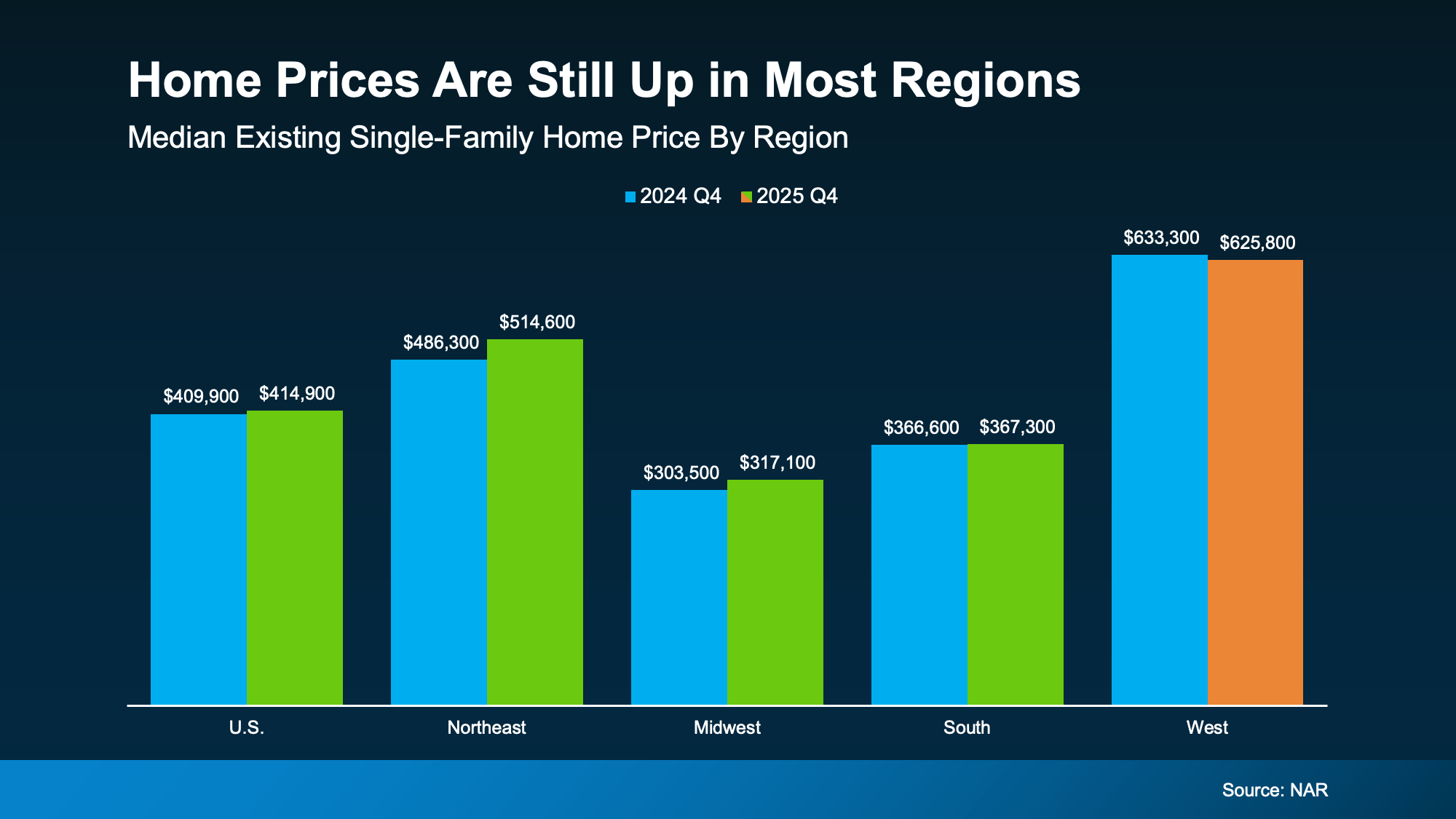 Home prices are up (or at least holding steady) in the Northeast, Midwest, and South. The West has seen some small declines in certain markets, but “small” is the key word.
There is no wave of falling prices across the country. Instead, there are just a few pockets adjusting after several years of what’s typically considered unsustainable or exponential growth.
Okay, but what about the places where prices have declined? According to ResiClub and Zillow, that’s not a cause for major concern. When you zoom out and look at those same markets over the past five years, the story changes (see graph below):
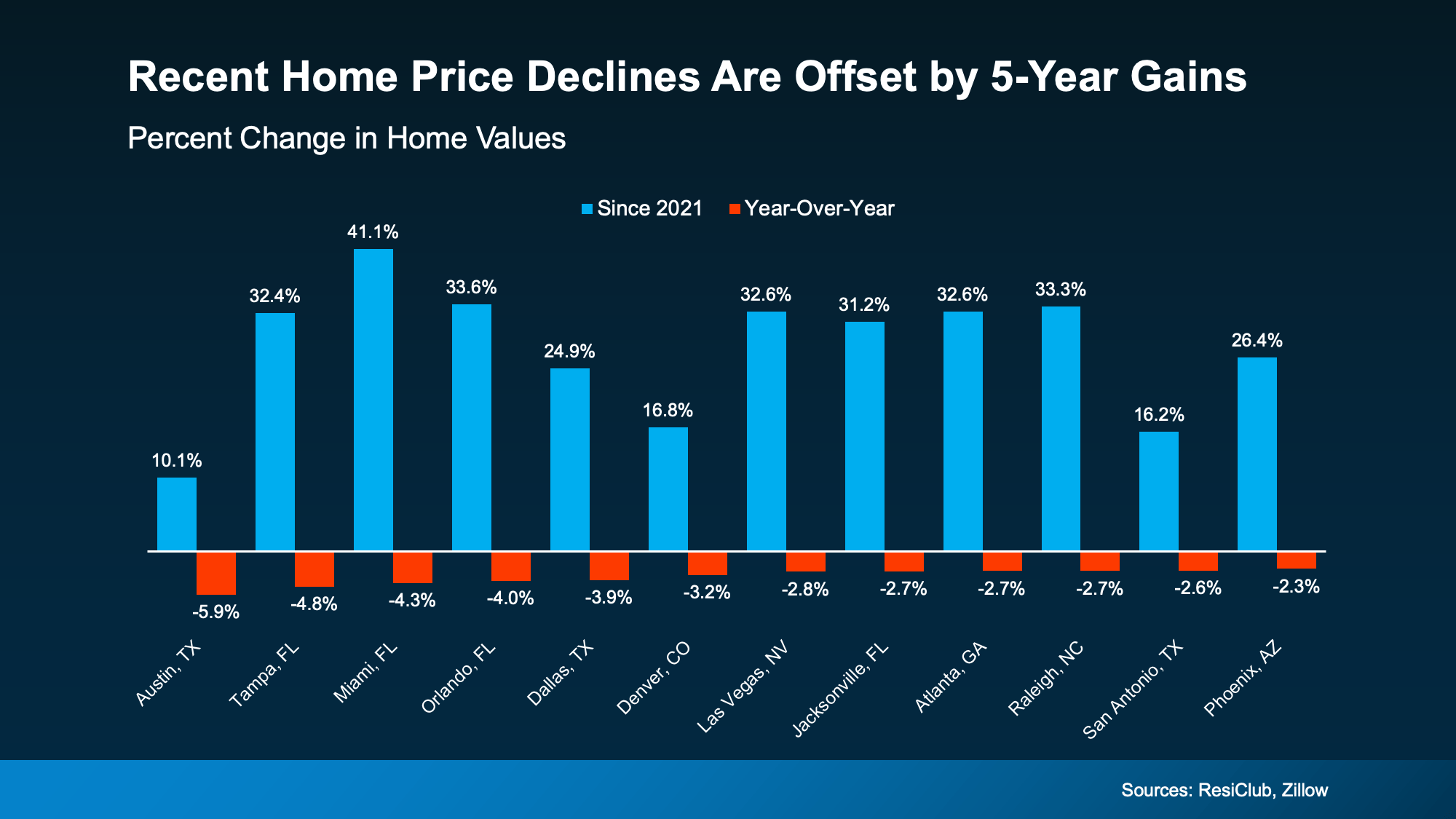 In the areas with recent declines, home values are still significantly higher than they were just five years ago. That’s a direct reflection of how much home values have gone up.
Online chatter tends to shine a spotlight on the few areas that are down. But the bigger picture shows most homeowners are still in a very strong position.
Of course, every market, and every home, is different. But broadly speaking, home values are holding steady. And this isn’t a sign of widespread trouble in the market.
Despite what you may be seeing online, home prices are rising or holding steady in most parts of the country.
If you’re curious what your home is worth today, let’s take a look at the numbers together. Because context, and local expertise, matter more than what you’re seeing online.
Interested in more real estate tips? Feel free to contact me directly!
Providing a superior level of informed, professional real estate services to buyers and sellers throughout Central Minnesota. We have agents specializing in residential, commercial, multifamily, new construction, existing, investment properties, foreclosures/REO, and short sales with offices located in:
Multiple Office Locations To Serve YOU!
Saint Cloud 320-259-4554
Princeton 320-983-3555
Sartell 320-259-4554
Little Falls 320-259-4554
Minneapolis 763-565-2000
Hutchinson 320-455-9127
Litchfield 320-298-1140
Premier Real Estate specializes in MANY areas around Central MN including Saint Cloud, Waite Park, Rice, Royalton, Sartell,
Who Has the Upper Hand in Today's Housing Market?Ask around and almost every homebuyer out there wants to know if there’s a way to get a better deal. And just about every seller wants to know
How to Find the Right Neighborhood When You MoveHouse hunters can focus so much on a house they want that they unintentionally slight other aspects of a new location. Your new neighborhood is at
Less House, More Home: Why Smaller Homes Are Paying Off for Today’s BuyersYou started shopping with a specific mental image of your future home in your mind. Then the houses in your budget
Do You Still Need a Home Office?Dedicated home offices are transitioning from must-haves to maybes, as many employees spend more days at the workplace. The home office isn’t disappearing, but
 The data relating to real estate for sale on this web site comes in part from the Broker Reciprocity Program of the Regional Multiple Listing Service of Minnesota, Inc. Real estate listings held by brokerage firms other than Premier Real Estate Services are marked with the Broker Reciprocity logo or the Broker Reciprocity thumbnail logo (little black
house) and detailed information about them includes the name of the listing brokers.
The data relating to real estate for sale on this web site comes in part from the Broker Reciprocity Program of the Regional Multiple Listing Service of Minnesota, Inc. Real estate listings held by brokerage firms other than Premier Real Estate Services are marked with the Broker Reciprocity logo or the Broker Reciprocity thumbnail logo (little black
house) and detailed information about them includes the name of the listing brokers.
The broker providing these data believes them to be correct, but advises interested parties to confirm them before relying on them in a purchase decision.
© 2026 Regional Multiple Listing Service of Minnesota, Inc. All rights
reserved
By searching, you agree to the End User License Agreement.
Digital Millennium Copyright Act (DMCA) Notice
The Digital Millennium Copyright Act of 1998, 17 U.S.C. 512 (the "DMCA"), provides recourse for copyright owners who believe that material appearing on the Internet infringes their rights under U.S. copyright law. If you believe in good faith that any content or material made available in connection with our website or services infringes your copyright, you (or your agent) may send us a notice requesting that the content or material be removed, or access to it blocked. Notices and counter-notices should be sent in writing by mail to Michael Bisping, Director, Customer Relations, Regional Multiple Listing Service of Minnesota, Inc, 2550 University Avenue West, Suite 259S
Saint Paul, MN 55114 or by email to mbisping@northstarmls.com. Questions can be directed by phone to 651-251-3200.
