
Who Has the Upper Hand in Today's Housing Market?Ask around and almost every homebuyer out there wants to know if there’s a way to get a better deal. And just about every seller wants to know

Dated: June 26 2025
Views: 81
Updated on June 25, 2025
Follow pro advice about how to cut your electric bills and use less electricity even with rising costs and summer heat.
The heat is on. Forecasts predict hotter-than-average temperatures across the U.S. this summer, with extreme heat likely in the Northeast and West, according to the National Oceanic and Atmospheric Administration. At the same time, electricity costs will hit a record 12-year high, says the National Energy Assistance Directors Association. The double whammy of soaring heat and electricity costs means you’ll want to know your options for how to use less electricity and cut your electric bills while keeping your home cool.
Basic economics says higher temps increase demand for electricity to run your air conditioning and blow your fans, leading to higher prices. Experts mention other possible culprits: energy companies covering capital expenditures to improve delivery infrastructure, more data centers consuming electricity, and tax cuts ending for alternative energy sources, placing more demand on fossil-fuel-powered plants.
Your electric bill shows the amount you’re paying to connect to the electrical grid, transmission fees, and various surcharges, along with the price of your electricity use per kilowatt hour (kWh). The average U.S. household uses 855 kWh of electricity per month, with an average price of 16.44 cents per kilowatt, according to the U.S. Energy Information Administration.
From June 2025 through September 2025, the average electric bill in the U.S. will be $787, up from $737 last summer and $660 only three summers ago, according to NEADA’s 2025 Summer Residential Cooling Outlook.
More than half of our energy use comes from cooling and heating, with about 18% of annual household electricity going to air conditioning, according to the EIA. As of 2020, 89% of U.S. homes used some type of air conditioning, and 67% have installed central air conditioning, according to the Environmental Protection Agency.
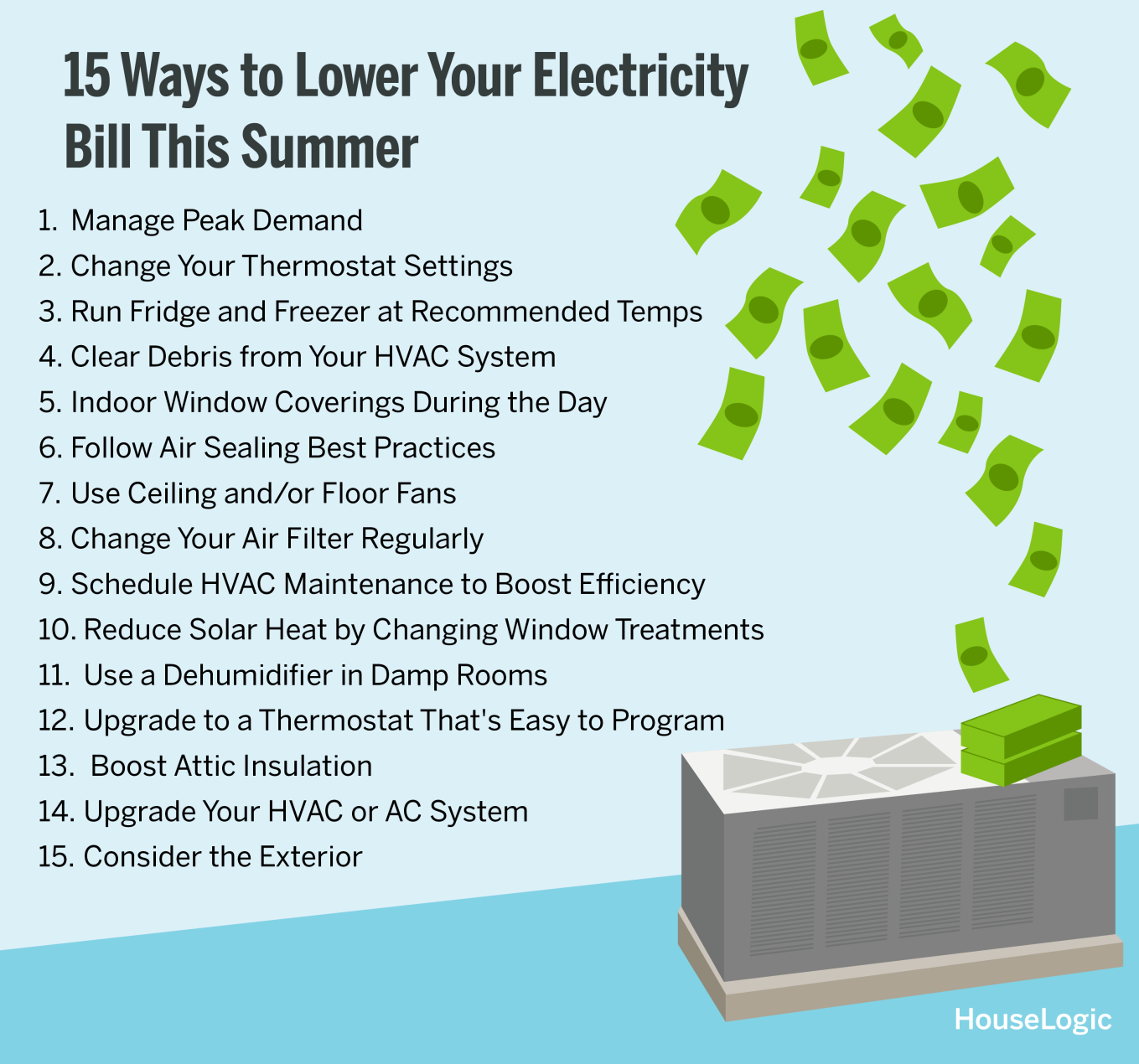
Here are 15 tips, listed from no-cost to higher-cost ideas, to cut your electric bill while cooling off:
“Check your utility company’s rates,” says Sam Gluck, master electrician and vice president and partner at APCO Electric in Denver. “During peak demand, where I live, our energy company charges three to four times the typical kilowatt cost. Choose when you want to consume power.”
“This will depend, in part, on the region of the country you live in,” says Mark Wolfe , executive director of NEADA. “In states with very high summer temperatures, it’s recommended to keep your AC/thermostat between 70 degrees Fahrenheit and 78 degrees when people are at home, and to keep the AC/thermostat at 78 degrees when the house is empty. The utility company Carolina Comfort notes that for every degree increased between those two temperatures, you will save 3% on your electric bill.”
“Running them at cooler temperatures might seem like a good idea in the summer, but that can drive up electricity costs and potentially wear out the electrical appliance,” Wolfe says.
Make sure nothing blocks the airflow from the system’s condenser. “That will affect how efficiently the unit can run, which will then affect energy usage,” Wolfe says.
Close your blinds or curtains to keep the cooler air inside during the day. If temperatures are low enough at night and the air quality is healthy, keep windows open for natural cooling.
“You want a tight building envelope [the building components that separate the indoors from the outdoors] and good ventilation, regardless of whether it’s heating or cooling season,” says Matt Daigle, CEO and founder of Rise, an online home improvement store focused on sustainability. Install door sweeps at the base of all doors from the interior of your home to the exterior and make sure all windows have functioning weatherstripping and all possible seams, cracks, and openings are sealed.
Fans don’t lower the temperature, but they do blow air across you, making you feel cooler. Running the fan counterclockwise in the summer pushes cooler air down.
Wolfe says the frequency will depend on which type of filter and which type of thermostat/AC your home has, “but during the summer it should be monthly for most homes.”
A clean drain pan and clean drain line mean the unit will run more efficiently, so right before summer starts is the optimal time for maintenance. Have a professional check your ductwork for leaks and tears in the HVAC system.
In cooling seasons, about 76% of sunlight that falls on standard double-pane windows enters to become heat, according to the Department of Energy. Cellular shades can reduce unwanted solar heat through windows by up to 60%, reducing the total solar gain to 20% when installed with a tight fit.
It’s especially effective in rooms like the basement and bathrooms, Wolfe says. “The more humid your home is, the warmer you will feel.”
Choose a smart thermostat or one that makes programming the HVAC system easier. “This could be a low-cost option for some people, but it may be costly due to the type of AC their home has and if it’s compatible with the newer technology,” Wolfe says.
Upgrade at a minimum of R-38, Wolfe says. Insulation is like your favorite insulated travel mug: It keeps hot contents hot and cold contents cold.
“Choose devices with a high ENERGY STAR rating or switch entirely from window AC units to central air,” Wolfe advises. Although window units concentrate cool air in specific rooms, if they’re not installed properly, they allow heat in along the edges. New products are available that offer a different configuration and a tighter seal. Or install a heat pump — a device that heats and cools.
Install exterior shading, such as awnings and eaves, along the house, especially where there are windows. Plant deciduous shade trees along the south and west sides of the home.
Know how many devices you have. “Anything plugged in is drawing electricity,” Gluck says. Think about the iPhone charger that’s always plugged in, appliances, computers, and printers. “These are all consuming power even if they’re turned off,” Gluck says.
This “phantom energy” or “vampire power” can add up to 20% to your monthly electric bill. To help you figure how much electricity you’re using, you could buy an energy monitoring device that hooks up to your electrical panel and shows in real time where your biggest draws are coming from, Daigle says. You can buy an energy monitoring device at a hardware store for $20 to $50.
You could also unplug the devices you aren’t using or use power strips with a switch to turn off several devices at once. A smart plug allows you to use a phone app to help you turn gadgets on and off and monitor energy use.
Now’s the time to start preparing not only for this summer but for long-term extreme weather. Your cooling and heating system go hand in hand.
If you’re creating a more energy-efficient home and thinking of selling, you just may get a return on your investment. A 2022 report by Freddie Mac showed that more energy-efficient and higher-performance homes sold for 3% to 5% more than lesser-rated homes.
Interested in more real estate tips? Feel free to contact me directly!
Providing a superior level of informed, professional real estate services to buyers and sellers throughout Central Minnesota. We have agents specializing in residential, commercial, multifamily, new construction, existing, investment properties, foreclosures/REO, and short sales with offices located in:
Multiple Office Locations To Serve YOU!
Saint Cloud 320-259-4554
Princeton 320-983-3555
Sartell 320-259-4554
Little Falls 320-259-4554
Minneapolis 763-565-2000
Hutchinson 320-455-9127
Litchfield 320-298-1140
Premier Real Estate specializes in MANY areas around Central MN including Saint Cloud, Waite Park, Rice, Royalton, Sartell,
Who Has the Upper Hand in Today's Housing Market?Ask around and almost every homebuyer out there wants to know if there’s a way to get a better deal. And just about every seller wants to know
How to Find the Right Neighborhood When You MoveHouse hunters can focus so much on a house they want that they unintentionally slight other aspects of a new location. Your new neighborhood is at
Less House, More Home: Why Smaller Homes Are Paying Off for Today’s BuyersYou started shopping with a specific mental image of your future home in your mind. Then the houses in your budget
Do You Still Need a Home Office?Dedicated home offices are transitioning from must-haves to maybes, as many employees spend more days at the workplace. The home office isn’t disappearing, but
 The data relating to real estate for sale on this web site comes in part from the Broker Reciprocity Program of the Regional Multiple Listing Service of Minnesota, Inc. Real estate listings held by brokerage firms other than Premier Real Estate Services are marked with the Broker Reciprocity logo or the Broker Reciprocity thumbnail logo (little black
house) and detailed information about them includes the name of the listing brokers.
The data relating to real estate for sale on this web site comes in part from the Broker Reciprocity Program of the Regional Multiple Listing Service of Minnesota, Inc. Real estate listings held by brokerage firms other than Premier Real Estate Services are marked with the Broker Reciprocity logo or the Broker Reciprocity thumbnail logo (little black
house) and detailed information about them includes the name of the listing brokers.
The broker providing these data believes them to be correct, but advises interested parties to confirm them before relying on them in a purchase decision.
© 2026 Regional Multiple Listing Service of Minnesota, Inc. All rights
reserved
By searching, you agree to the End User License Agreement.
Digital Millennium Copyright Act (DMCA) Notice
The Digital Millennium Copyright Act of 1998, 17 U.S.C. 512 (the "DMCA"), provides recourse for copyright owners who believe that material appearing on the Internet infringes their rights under U.S. copyright law. If you believe in good faith that any content or material made available in connection with our website or services infringes your copyright, you (or your agent) may send us a notice requesting that the content or material be removed, or access to it blocked. Notices and counter-notices should be sent in writing by mail to Michael Bisping, Director, Customer Relations, Regional Multiple Listing Service of Minnesota, Inc, 2550 University Avenue West, Suite 259S
Saint Paul, MN 55114 or by email to mbisping@northstarmls.com. Questions can be directed by phone to 651-251-3200.
