
Who Has the Upper Hand in Today's Housing Market?Ask around and almost every homebuyer out there wants to know if there’s a way to get a better deal. And just about every seller wants to know

Dated: March 21 2025
Views: 105
Homeowner’s insurance is a must-have to protect what’s probably your biggest investment – your home. And while you never want to think about worst-case scenarios, the right coverage is basically your safety net if something goes wrong. Here’s how it helps you.
In the simplest sense, it gives you peace of mind. Knowing you have protection against unexpected events helps you worry less. And with such a big purchase, having that reassurance is a big deal.
And while your first insurance payment will be wrapped into your closing costs, you’ll want this to be a part of your budget beyond closing day too. That’s because it's a recurring expense you’ll have once you get the keys to your home.
Here’s what you need to know to help you budget for this important part of homeownership today.
In recent years, insurance costs have been climbing. According to Insurance.com, there are four big reasons behind the jump in premiums:
Basically, disasters are happening more often, repairs cost more, and insurers have to adjust their rates to keep up. Data from ICE Mortgage Technology helps paint the picture of how the average yearly premium has climbed over the last decade (see graph below):
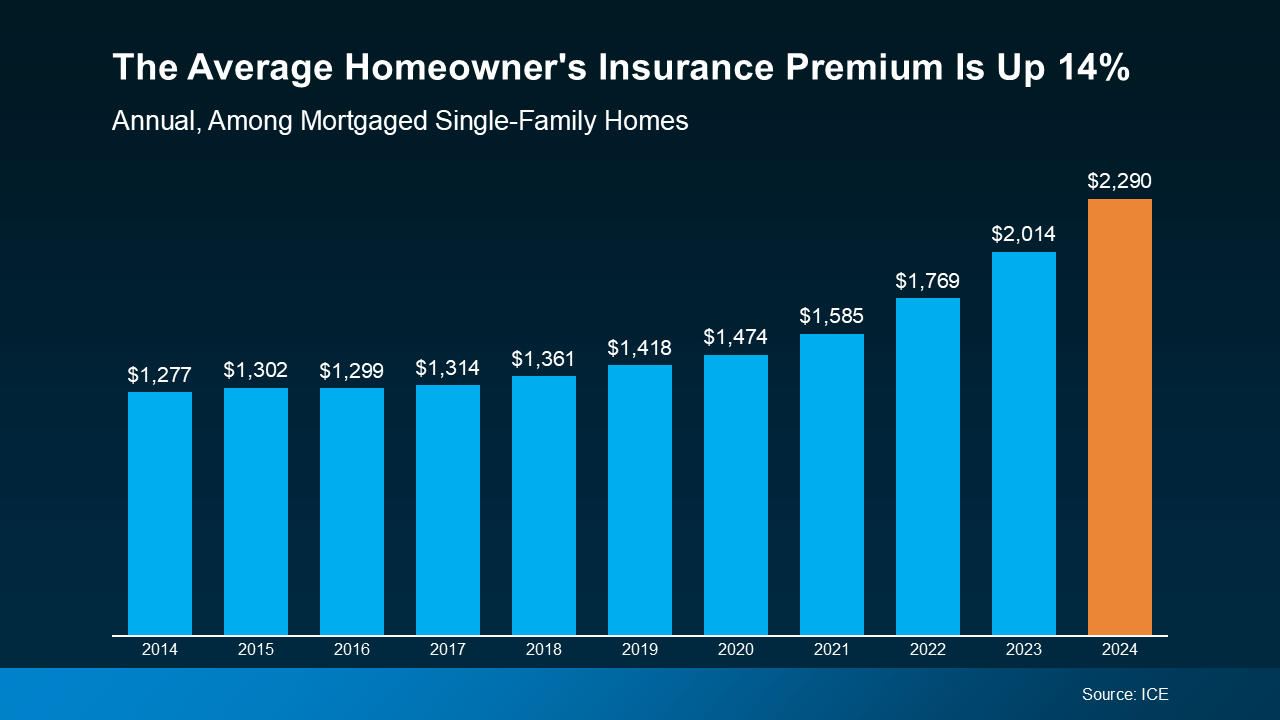
Homeowner’s insurance is a must to protect your home and your investment. But with costs rising, you’ll want to do your homework to balance the best coverage you can get at the best price possible.
Homeowner’s insurance rates vary widely based on location, provider, and coverage. Shop around and compare quotes before settling on a policy. And don’t forget to ask about discounts. Things like security systems or bundling with auto insurance could help lower your insurance costs.
When you’re planning to buy a home, it’s important to look beyond just your mortgage payment. You’ll also want to budget for your homeowner’s insurance policy. It gives you a lot of protection against the unexpected. And while it’s true those costs are rising, there are things you can do to try to get the best price possible.
What’s your biggest concern when it comes to budgeting for homeownership? Let’s talk through it and make sure you’re set up for success.
Interested in more real estate tips? Contact me directly!
At Premier Real Estate Services, we deliver outstanding, professional guidance to buyers and sellers throughout Central Minnesota. Our expert agents specialize in residential, commercial, multifamily, new construction, existing properties, investments, foreclosures/REO, and short sales. With multiple office locations, we’re ready to serve you:
Saint Cloud (320-259-4554)
Princeton (320-983-3555)
Sartell (320-259-4554)
Little Falls (320-259-4554)
Minneapolis (763-565-2000)
Hutchinson (320-455-9127)
Litchfield (320-298-1140)
We proudly assist clients in Saint Cloud, Waite Park, Rice, Royalton, Sartell, Little Falls, Cold Spring, Saint Joseph, Elk River, Monticello, Ramsey, Saint Michael, Andover, Ham Lake, Anoka, Champlin, Buffalo, Glencoe, Brownton, Silver Lake, Kandiyohi, Dassel, Minneapolis, Maple Grove, Saint Louis Park, Saint Paul, Robbinsdale, Crystal, New Hope, Brooklyn Center, Brainerd, Nisswa, Aitkin, Albany, Coon Rapids, Sauk Rapids, and more! Let us help make your real estate dreams a reality.
Who Has the Upper Hand in Today's Housing Market?Ask around and almost every homebuyer out there wants to know if there’s a way to get a better deal. And just about every seller wants to know
How to Find the Right Neighborhood When You MoveHouse hunters can focus so much on a house they want that they unintentionally slight other aspects of a new location. Your new neighborhood is at
Less House, More Home: Why Smaller Homes Are Paying Off for Today’s BuyersYou started shopping with a specific mental image of your future home in your mind. Then the houses in your budget
Do You Still Need a Home Office?Dedicated home offices are transitioning from must-haves to maybes, as many employees spend more days at the workplace. The home office isn’t disappearing, but
 The data relating to real estate for sale on this web site comes in part from the Broker Reciprocity Program of the Regional Multiple Listing Service of Minnesota, Inc. Real estate listings held by brokerage firms other than Premier Real Estate Services are marked with the Broker Reciprocity logo or the Broker Reciprocity thumbnail logo (little black
house) and detailed information about them includes the name of the listing brokers.
The data relating to real estate for sale on this web site comes in part from the Broker Reciprocity Program of the Regional Multiple Listing Service of Minnesota, Inc. Real estate listings held by brokerage firms other than Premier Real Estate Services are marked with the Broker Reciprocity logo or the Broker Reciprocity thumbnail logo (little black
house) and detailed information about them includes the name of the listing brokers.
The broker providing these data believes them to be correct, but advises interested parties to confirm them before relying on them in a purchase decision.
© 2026 Regional Multiple Listing Service of Minnesota, Inc. All rights
reserved
By searching, you agree to the End User License Agreement.
Digital Millennium Copyright Act (DMCA) Notice
The Digital Millennium Copyright Act of 1998, 17 U.S.C. 512 (the "DMCA"), provides recourse for copyright owners who believe that material appearing on the Internet infringes their rights under U.S. copyright law. If you believe in good faith that any content or material made available in connection with our website or services infringes your copyright, you (or your agent) may send us a notice requesting that the content or material be removed, or access to it blocked. Notices and counter-notices should be sent in writing by mail to Michael Bisping, Director, Customer Relations, Regional Multiple Listing Service of Minnesota, Inc, 2550 University Avenue West, Suite 259S
Saint Paul, MN 55114 or by email to mbisping@northstarmls.com. Questions can be directed by phone to 651-251-3200.
