
Who Has the Upper Hand in Today's Housing Market?Ask around and almost every homebuyer out there wants to know if there’s a way to get a better deal. And just about every seller wants to know

Dated: May 13 2026
Views: 29

You've probably seen the headlines saying, "foreclosures are on the rise,” and maybe your mind jumped straight to 2008. That’s understandable. A lot of people remember that crash and all the foreclosures that happened during that window, and they’re hoping something like that never happens again.
But this isn’t a repeat of what happened back then. Here’s the context to prove it.
Yes, foreclosure filings are up 26% from a year ago, according to ATTOM. And they’ve been rising for 5 straight quarters. That's a real trend worth paying attention to. But the full picture isn’t scary like the headlines suggest.
The reality is the increase we’re seeing is a sign of the market normalizing.
Here's an important thing to know about this chart. The extremely low numbers you see in 2020 and 2021 don't represent what's "normal." That's when the government put a moratorium on foreclosures to help homeowners get through the pandemic. Those years were an exception, not the baseline.
Instead, compare where we are today to 2017, 2018, and 2019 – the last years the market was running normally. Today's numbers are still lower. So, we're not even back to what's typical, yet. That means this can’t be a crash. (see graph below):
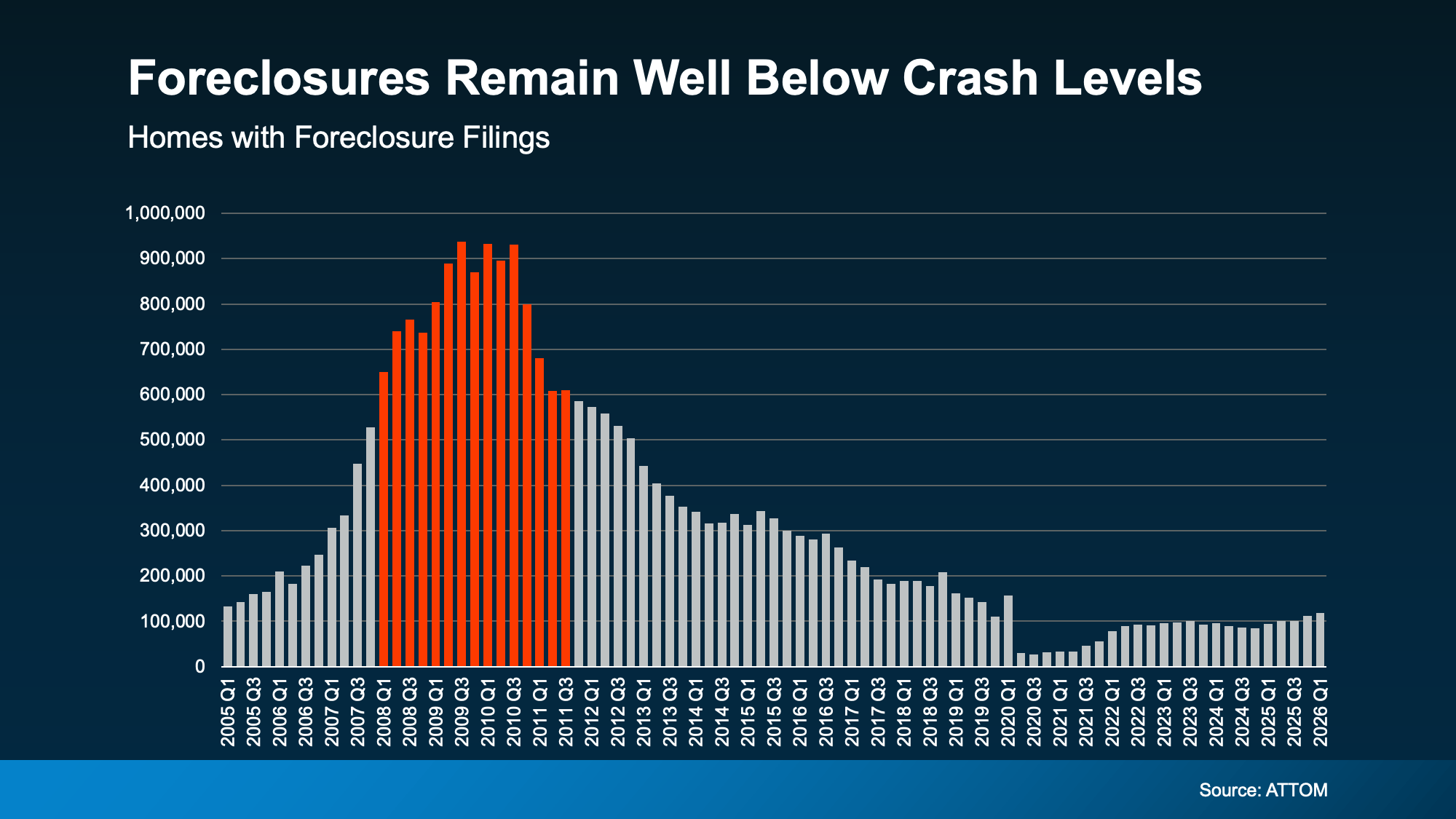 While today's numbers are getting closer to pre-pandemic levels, they're still below historical norms. And just look at what was happening around 2008. Even with the recent increase, we're nowhere near those levels. This is a market returning to normal, not heading toward a crisis.
Most of those filings won't even end in a completed foreclosure. That's because today's homeowners have something most people in 2008 simply didn't have. And that’s equity.
The average homeowner today is sitting on roughly $295,000 in home equity right now, according to Cotality. Back in 2008, many people owed more than their homes were worth. Selling wasn't an option. And foreclosure was often the only door available.
Today, that's not the case. If you have enough equity to cover what you owe and the cost of selling, you could sell your home, pay off your debt, protect your credit, and potentially walk away with money in your pocket.
That's a completely different situation than what homeowners faced during the last crash, and it's a big reason we're unlikely to see foreclosures spiral the way they did back then.
Check out the graph below. It shows foreclosure data from ATTOM going back to 2005. Here's how to read it:
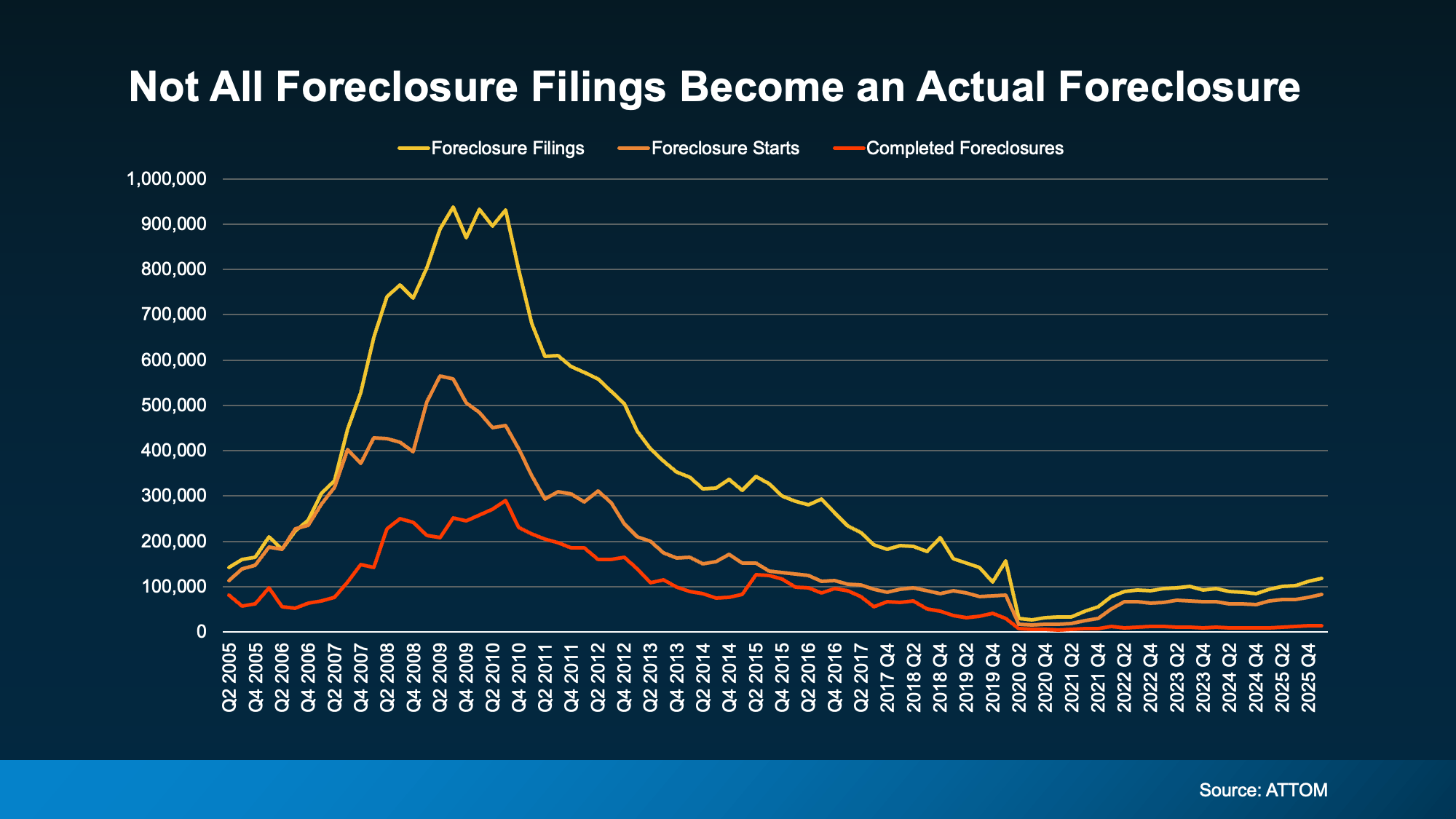 See how the red line stays well below the other two? That gap tells the real story. A lot of homeowners who enter the foreclosure process never end up losing their home because they find another way forward first.
Today’s equity is a big reason for that. So, even the filings we are seeing now won’t all end in foreclosure.
Maybe you're behind on payments. Maybe you're stressed about what comes next. That's an incredibly hard place to be, but it's important to know that missing a payment or two doesn't automatically mean you'll lose your home.
Banks would much rather work with you than foreclose. It's a complicated, costly process for them, too. They're often willing to set up a repayment plan, offer forbearance (a temporary pause or reduction in your payments), or modify your loan to make things more manageable long-term.
Just know the sooner you reach out to your lender, the more options you'll have. In some states (ones that don't require the foreclosure process to go through a court) things can move faster than people expect. Getting ahead of it early gives you and your lender the most room to find a solution.
And if selling makes more sense for your situation, a real estate agent can help you understand what your home is worth and whether that's a path worth exploring.
Foreclosure filings may be rising, but they're still low. And the equity most homeowners are sitting on today is a key reason this looks nothing like 2008.
Interested in more real estate tips? Feel free to contact me directly!
Providing a superior level of informed, professional real estate services to buyers and sellers throughout Central Minnesota. We have agents specializing in residential, commercial, multifamily, new construction, existing, investment properties, foreclosures/REO, and short sales with offices located in:
Multiple Office Locations To Serve YOU!
Saint Cloud 320-259-4554
Princeton 320-983-3555
Sartell 320-259-4554
Little Falls 320-259-4554
Minneapolis 763-565-2000
Hutchinson 320-455-9127
Litchfield 320-298-1140
Premier Real Estate specializes in MANY areas around Central MN including Saint Cloud, Waite Park, Rice, Royalton, Sartell,
Who Has the Upper Hand in Today's Housing Market?Ask around and almost every homebuyer out there wants to know if there’s a way to get a better deal. And just about every seller wants to know
How to Find the Right Neighborhood When You MoveHouse hunters can focus so much on a house they want that they unintentionally slight other aspects of a new location. Your new neighborhood is at
Less House, More Home: Why Smaller Homes Are Paying Off for Today’s BuyersYou started shopping with a specific mental image of your future home in your mind. Then the houses in your budget
Do You Still Need a Home Office?Dedicated home offices are transitioning from must-haves to maybes, as many employees spend more days at the workplace. The home office isn’t disappearing, but
 The data relating to real estate for sale on this web site comes in part from the Broker Reciprocity Program of the Regional Multiple Listing Service of Minnesota, Inc. Real estate listings held by brokerage firms other than Premier Real Estate Services are marked with the Broker Reciprocity logo or the Broker Reciprocity thumbnail logo (little black
house) and detailed information about them includes the name of the listing brokers.
The data relating to real estate for sale on this web site comes in part from the Broker Reciprocity Program of the Regional Multiple Listing Service of Minnesota, Inc. Real estate listings held by brokerage firms other than Premier Real Estate Services are marked with the Broker Reciprocity logo or the Broker Reciprocity thumbnail logo (little black
house) and detailed information about them includes the name of the listing brokers.
The broker providing these data believes them to be correct, but advises interested parties to confirm them before relying on them in a purchase decision.
© 2026 Regional Multiple Listing Service of Minnesota, Inc. All rights
reserved
By searching, you agree to the End User License Agreement.
Digital Millennium Copyright Act (DMCA) Notice
The Digital Millennium Copyright Act of 1998, 17 U.S.C. 512 (the "DMCA"), provides recourse for copyright owners who believe that material appearing on the Internet infringes their rights under U.S. copyright law. If you believe in good faith that any content or material made available in connection with our website or services infringes your copyright, you (or your agent) may send us a notice requesting that the content or material be removed, or access to it blocked. Notices and counter-notices should be sent in writing by mail to Michael Bisping, Director, Customer Relations, Regional Multiple Listing Service of Minnesota, Inc, 2550 University Avenue West, Suite 259S
Saint Paul, MN 55114 or by email to mbisping@northstarmls.com. Questions can be directed by phone to 651-251-3200.
